
Nov 18, 2026 · Matthew Jones
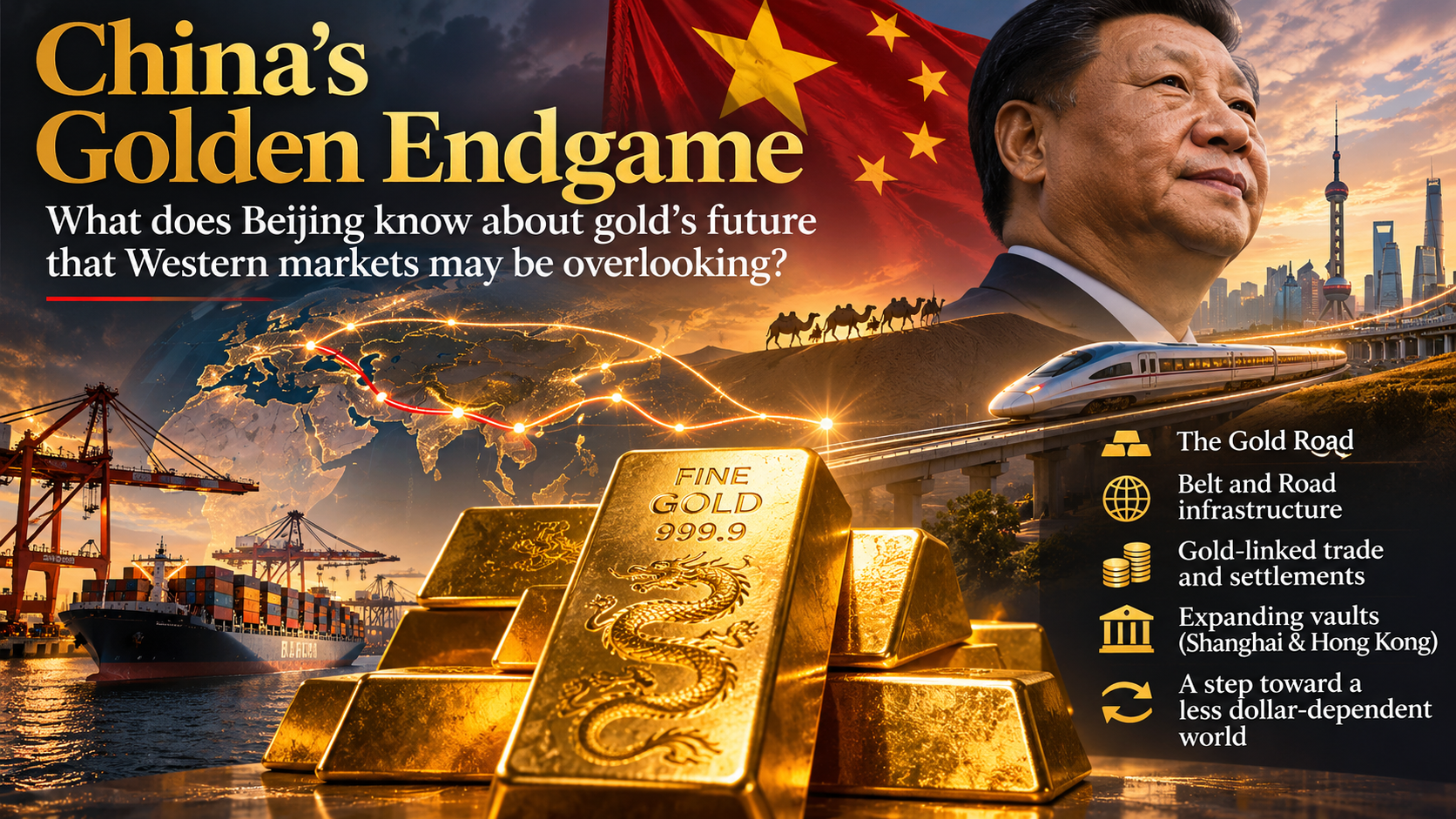
What does Beijing know about gold's future that Western markets may be overlooking?
By Matthew Jones | Co-Founder & Precious Metals Analyst, Britannia Bullion
18 November 2026
Gold has fallen sharply from its record highs.
Western investors are being told the familiar story. A stronger dollar, higher bond yields, changing interest-rate expectations and profit-taking are weighing on the precious metal.
And yet China continues buying.
But perhaps we're asking the wrong question.
The interesting question isn't why China is buying gold now that prices have fallen.
It's why China was buying so much gold when it was considerably more expensive.
Why would one of the world's largest economies continue accumulating physical gold at elevated prices, knowing perfectly well that markets rise and fall?
Perhaps because China isn't particularly concerned about where gold trades next Tuesday.
Perhaps it's thinking about where the global monetary system will be ten years from now.
And when we look beyond the daily gold price, something rather extraordinary is taking shape.
The Gold Road
For years, China has been developing its Belt and Road Initiative, an enormous network of infrastructure, transport, energy and trade relationships stretching across Asia, the Middle East, Africa and Europe.
Railways, ports, roads, pipelines and trading relationships.
But there's another network emerging alongside it.
One built around gold.
Often described as China's Gold Road, or Gold Corridor, the strategy seeks to expand gold trading, storage and settlement infrastructure, particularly through the Shanghai Gold Exchange and its international connections.
And this isn't simply speculation.
In August 2026, S&P Global published research identifying gold as an increasingly important component of China's national security, reserve diversification and internationalisation strategy.
The objective is not merely to own more gold.
It's to build the infrastructure through which gold can be traded, stored, delivered and potentially used to support international financial relationships.
China isn't simply accumulating the asset. It's helping build the market around it.
Shanghai, Hong Kong and the New Gold Infrastructure
Consider what's already happened.
The Shanghai Gold Exchange has developed an international trading platform that allows overseas participants to trade gold using renminbi.
In June 2025, it opened its first offshore gold delivery vault in Hong Kong, accompanied by renminbi-denominated contracts offering physical delivery.
Then, in July 2026, Hong Kong began trial operations of a central gold clearing and settlement system, alongside a new connection with the Shanghai Gold Exchange.
The significance is easily overlooked.
China is creating more ways for international participants to trade gold, hold physical bullion and settle transactions through infrastructure increasingly connected to Chinese financial markets.
Hong Kong is also seeking to expand its role as an international gold storage and trading centre.
And the ambition extends beyond Hong Kong.
Reports have described efforts to develop an international network of gold vaults, with countries including Cambodia exploring the use of Chinese-linked storage facilities.
This is not the behaviour of a country simply hoping to profit from a rising commodity price.
It looks increasingly like a country preparing gold for a larger role in the financial system.
From the Belt and Road to the Gold Road
Now consider the possibilities.
China has spent years building commercial relationships with countries that supply the energy, minerals, food and raw materials its economy requires.
Many of those countries are also interested in reducing their dependence on the US dollar.
Traditionally, international trade has relied heavily on dollar-denominated transactions and Western financial infrastructure.
But what happens if trading partners increasingly have alternatives?
Imagine a commodity-producing country selling resources to China.
Instead of relying exclusively on dollars, the transaction could be settled in renminbi.
That currency could then be used to purchase Chinese goods, invested in Chinese assets or exchanged through a developed gold market.
Gold would not necessarily need to change hands with every shipment.
Its availability as a widely recognised, internationally traded asset could help make a renminbi-based financial relationship more attractive.
That is an important distinction.
China does not need to make every yuan redeemable for gold to make gold strategically useful to the yuan.
And if China continues expanding its vaults, exchanges, delivery systems and trading relationships, those options become increasingly practical.
The Gold Road could therefore become an important financial companion to the Belt and Road.
One builds the physical infrastructure for international trade.
The other helps build the financial infrastructure supporting it.
Gold-Backed Trade: The Next Step?
There has been considerable speculation about BRICS nations developing a new gold-backed currency.
We should be careful here.
There is currently no established, universally adopted BRICS gold-backed currency replacing the dollar.
Proposals for gold-linked settlement instruments exist, including concepts that would combine gold with participating nations' currencies. But proposals should not be confused with functioning international monetary systems.
Nevertheless, the direction of travel is interesting.
Countries are exploring ways to settle more trade in their own currencies and reduce dependence on existing international payment arrangements.
Gold could potentially play a supporting role.
Not necessarily as the currency itself, but as a reserve asset, collateral or an alternative means of holding value between trading partners.
Imagine two countries conducting substantial trade but reluctant to accumulate large balances of each other's currencies.
Gold could provide a mutually recognised asset within a broader settlement arrangement.
And unlike a foreign government bond, physical gold does not depend on the issuing government honouring a debt obligation.
It is an asset without the same issuer credit risk.
That distinction has become increasingly important in a world of financial sanctions, geopolitical rivalry and rising sovereign debt.
Gold doesn't have to replace money to become more important to the way money moves.
Why Buy at the Higher Price?
Which brings us back to China's purchases.
According to the World Gold Council, the People's Bank of China added approximately 26 tonnes of gold during October 2026, extending its reported purchasing streak to 24 consecutive months.
China was also buying when gold traded at substantially higher levels.
Of course, central banks have many reasons to diversify their reserves, and we cannot know Beijing's private intentions simply by examining its purchases.
But consider the difference between two types of buyer.
A Western investment fund may purchase gold because it expects prices to rise over the next six months.
If interest-rate expectations change, it may sell.
A central bank thinking about the next ten or twenty years has a very different objective.
Its priorities may include monetary resilience, diversification, financial sovereignty and reducing dependence on another country's currency or financial institutions.
For such a buyer, the difference between purchasing at £3,000 or £4,000 an ounce may be less important than securing the physical gold it considers strategically necessary.
That doesn't mean price is irrelevant.
Nor does it guarantee China's strategy will succeed.
But it helps explain why gold purchases might continue even when short-term market conditions appear unfavourable.
Perhaps Beijing isn't trying to predict the next gold price.
Perhaps it's preparing for the next monetary system.
Does This Mean the End of the Dollar?
Not tomorrow. And probably not in the dramatic fashion some commentators predict.
The dollar remains overwhelmingly important to global trade, financial markets and international reserves.
According to the International Monetary Fund, it still represented approximately 56.7% of allocated global foreign exchange reserves in the second quarter of 2026.
The renminbi accounted for only around 2.1%.
That is an enormous gap.
China also faces significant obstacles, including restrictions on capital movements, questions about financial transparency and the willingness of international investors to hold renminbi assets.
But perhaps replacing the dollar entirely isn't the objective.
Perhaps the ambition is simply to create credible alternatives.
A world where countries can conduct more trade without first obtaining dollars.
Where more physical gold is stored and traded through Asian financial centres.
Where international commerce becomes less dependent on any single financial system.
And where gold has a greater role in supporting confidence between nations that may not entirely trust one another.
That would represent a substantial change even if the dollar remained the world's leading reserve currency.
The dollar doesn't have to collapse for gold's international importance to increase.
The Price of Gold Versus the Purpose of Gold
And this brings us to what may be the most important distinction of all.
Western markets tend to discuss gold in terms of price.
Is it going up?
Is it going down?
What will the Federal Reserve do next?
Will the dollar strengthen?
Should investors buy, sell or take profits?
All legitimate questions.
But China appears to be asking a rather different set of questions.
How much physical gold should we hold?
Where should it be stored?
How can we expand international trading and settlement?
How can gold strengthen our financial relationships?
And how can we reduce reliance on systems controlled by geopolitical rivals?
Those are strategic questions rather than short-term trading decisions.
And they suggest that gold's significance may extend far beyond the price displayed on a financial news website.
After all, the gold price tells us what the market is prepared to pay today.
It doesn't necessarily tell us what governments believe gold may be needed for tomorrow.
The Bigger Question
Nobody knows precisely how the international monetary system will look in ten years.
The dollar may remain dominant. The renminbi may expand its role. New payment networks may emerge, and gold may become more important without any formal return to a gold standard.
But one thing is increasingly clear.
China is not simply talking about gold.
It is accumulating physical reserves, developing trading infrastructure, expanding vaulting and settlement arrangements and strengthening connections with international partners.
All while Western investors debate whether the next interest-rate decision will push gold higher or lower.
And perhaps that is the real story.
Not whether gold returns to its previous high next month.
Not whether the latest correction has another few percentage points to run.
But why one of the world's largest economies continues investing in the metal and the infrastructure surrounding it.
Because if China believes gold has an important role to play in the next chapter of the global monetary system, perhaps we should be paying less attention to what gold costs today.
And considerably more attention to what China is preparing to use it for tomorrow.
About the Author
Matthew Jones is Co-Founder and Precious Metals Analyst at Britannia Bullion, specialising in physical gold, wealth preservation and the economic forces shaping precious metals markets.
A regular contributor to Kitco News, Matthew writes about inflation, monetary policy, geopolitical uncertainty and the changing forces shaping global financial systems.
His work focuses on helping individuals understand the risks to their wealth and the role physical gold can play in protecting purchasing power over the long term.